Pumpkin Seeds (Pepitas)
Pumpkin seeds pack a serious nutritional punch and bring a satisfying crunch to everything from salads to snacks.
In a nutshell
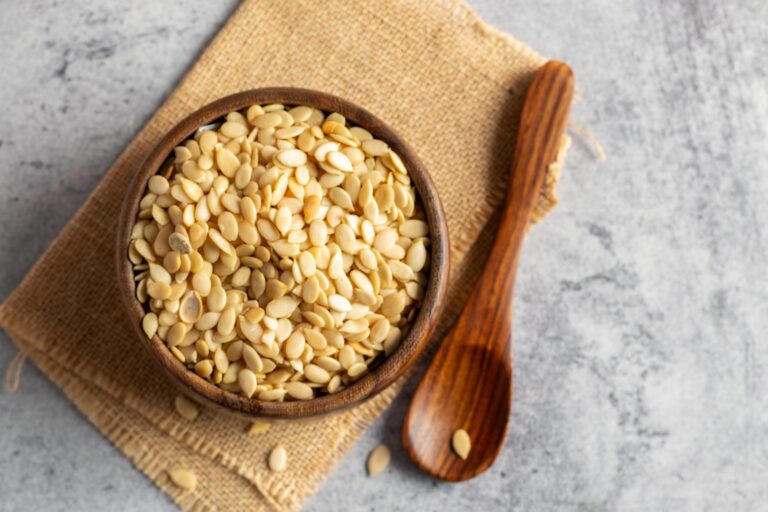
Pumpkin seeds — sold hulled as pepitas — are the edible kernels of pumpkin and certain squash varieties. They’re flat, oval, and range from pale green to dark green depending on the variety. Mild and nutty raw, they turn rich and almost buttery when toasted.
Nutrition
≈ 75 Calories and 6.6g fat per tablespoon.
Pepitas are a solid plant-based protein source, delivering roughly 19–20 grams of protein per 100g — a respectable amount among seeds and nuts. The fat content is predominantly heart-friendly unsaturated fat, with polyunsaturated fatty acids (including omega-6) making up the largest share and monounsaturated fats close behind. They’re an excellent source of magnesium, which supports muscle function and sleep quality, along with zinc, iron, and manganese. Pepitas also supply tryptophan, an amino acid precursor to serotonin, and contain antioxidants including vitamin E and carotenoids. Fiber content is modest but meaningful, helping with satiety, and sodium is naturally very low. Nutrition per 100 g.
Culinary uses & pairings
Raw pepitas are wonderful stirred into overnight oats, blended into smoothies, or scattered over yogurt for texture. They’re a natural fit in trail mix and homemade granola, and can be ground into a seed butter that works much like peanut butter for those with tree nut allergies.
Toasting pepitas in a dry skillet or tossing them with olive oil and spices before roasting unlocks their best flavor. Use them to finish soups (especially butternut squash or black bean), top grain bowls and salads, press into the crust of salmon or chicken, or fold into mole sauces and Mexican-inspired salsas where they’ve been a key ingredient for centuries.
Pairs well with
Substitutions
Buying & storage
Look for pepitas in the bulk bins or the baking aisle of most grocery stores, and in Latin markets where they’re often fresher and less expensive. Choose seeds that are uniformly green without yellowing or off-smells — rancid fat is the number one quality issue. Raw unsalted pepitas give you the most flexibility in the kitchen. If you buy pre-roasted versions, check that salt or oil is the only added ingredient.
Types
- Hull-less (Styrian) pepitas: Grown from hull-less pumpkin varieties — most commonly Cucurbita pepo var. styriaca — these are the bright green, tender seeds sold as pepitas at the store. No shell-cracking needed.
- White-hulled pumpkin seeds: The ivory-shelled seeds you can scoop from a carving pumpkin. Edible after roasting but tougher and chewier than hull-less pepitas; great for seasonal snacking.
- Roasted and salted: The most common snack form, typically made from hull-less pepitas. Convenient but watch sodium levels if you’re using them in recipes that call for unsalted seeds.
- Pepita oil pressed: Dark, intensely nutty pumpkin seed oil is cold-pressed from roasted pepitas and used as a finishing oil, especially in Austrian and Slovenian cuisine.
Recipes using pumpkin seeds
20 recipes across our recipe sites use pumpkin seeds. A few favorites:
Cooking with pumpkin seeds tonight?
Find pumpkin seeds recipes that match your diet — keto, high-protein, vegan, under 30 minutes — and build a shopping list in one tap.
History & origin
Pumpkins and their seeds have been cultivated in Mesoamerica for at least 7,500 years, making pepitas one of the oldest cultivated foods in the Americas. Indigenous peoples of Mexico and Central America used pumpkin seeds both as food and medicine long before European contact, incorporating them into sauces, stews, and ceremonial dishes. Spanish explorers brought seeds back to Europe in the 16th century, and cultivation spread rapidly. In the Styria region of Austria, a hull-less variety was developed that made large-scale seed oil production practical, and Styrian pumpkin seed oil became a regional specialty still prized today. In the United States, pepitas moved from Latin grocery stores into mainstream supermarkets during the health food boom of the late 20th century.
How it’s made
Hull-less pepitas come from specific pumpkin varieties bred to produce seeds without a hard fibrous shell. At harvest, the pumpkins are cracked open and the seeds are separated from the pulp, then washed and dried. Commercial drying is done at low temperatures to preserve the delicate fats. For conventional pumpkins, the seeds must be dried and the white hull removed by hulling machines before the green kernel inside is sold as a pepita. Roasted pepitas are either dry-roasted in large drums or oven-roasted with oil; seasoning is added immediately after roasting while the seeds are still warm so it adheres well.
Good to know
- The word pepita comes from Mexican Spanish meaning ‘little seed of squash’ — it’s technically only correct for the hull-less green kernel, not the whole white-shelled seed.
- Pepitas contain all nine essential amino acids but are not considered a complete protein in practical terms because lysine levels are too low to meet requirements on their own; pairing them with other foods fills that gap.
- Pumpkin seed oil from Styria, Austria, is so dark it looks almost black in the bottle but turns ruby red when held up to light — locals drizzle it over vanilla ice cream.
- Traditional Mexican mole pipián sauces are built on a base of ground pepitas, making them one of the earliest recorded nut-and-seed-based sauces in culinary history.
- Studies suggest that the high zinc content in pepitas may support prostate health, which is why they’ve been used in folk medicine for urinary tract issues for centuries.