Cumin Seed
Cumin seed is the earthy, warming spice that gives countless global dishes their unmistakable depth and soul.
In a nutshell
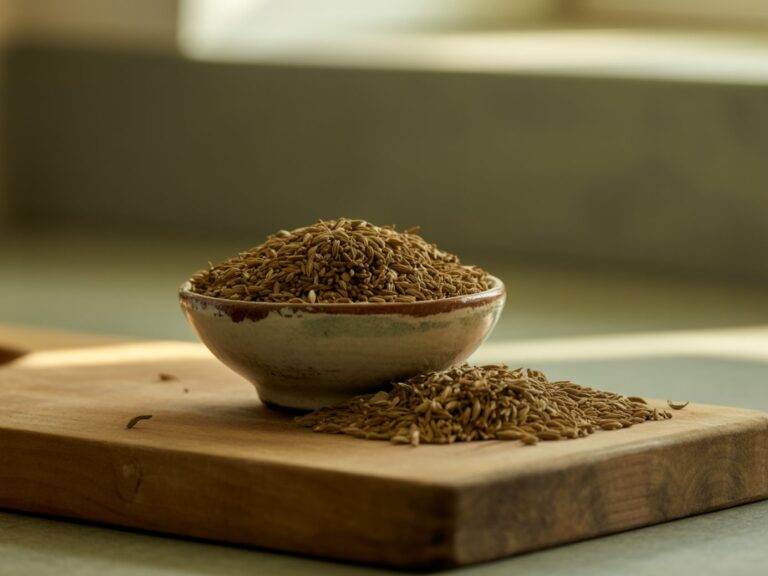
Cumin seed is a small, ridged seed from a plant in the parsley family, prized for its warm, slightly smoky, and faintly bitter flavor. It’s a backbone spice in Mexican, Indian, Middle Eastern, and North African cooking. Use it whole in hot oil or ground in rubs and spice blends.
Nutrition
≈ 51 Calories and 3g fat per tablespoon.
Cumin seed is more nutritionally dense than you might expect from something used by the pinch. It delivers a meaningful amount of plant-based protein and a solid hit of dietary fiber, both of which support satiety and digestive health. Its fat content includes both monounsaturated and polyunsaturated fatty acids. Cumin is also a notable source of iron, which is important for energy and oxygen transport in the body, as well as manganese and other trace minerals. Traditional medicine has long credited cumin with aiding digestion, and modern research points to active compounds like cuminaldehyde as responsible for both its distinctive aroma and potential antioxidant and anti-inflammatory properties. Nutrition per 100 g.
Culinary uses & pairings
Whole cumin seeds are classically bloomed in hot oil or ghee at the start of cooking — a technique called tarka in South Asian kitchens — which causes the seeds to sizzle, pop, and release a rich, toasty fragrance that infuses the entire dish. Use them this way as the flavor base for lentil soups, rice pilafs, curries, and sautéed vegetables. They’re equally at home in bread doughs, crackers, and cheese crusts where they add a savory, aromatic crunch.
Ground cumin is one of the most versatile spice-cabinet workhorses a home cook can have. It’s a cornerstone of taco seasoning, chili powder, garam masala, and ras el hanout. Stir it into hummus, yogurt sauces, and salad dressings for an earthy underpinning, or rub it onto chicken, lamb, pork, or beef before grilling or roasting. A small pinch can also round out tomato-based sauces and even some baked goods with unexpected warmth.
Pairs well with
Substitutions
Buying & storage
Look for whole cumin seeds that are uniform in color — a consistent grayish-brown with no significant fading or dark patches — and that smell intensely fragrant when you crush one between your fingers. Seeds sold in bulk bins at a high-turnover store or in sealed bags that list a harvest or packing date are your best bet for potency. Pre-ground cumin is convenient but loses its volatile oils (and therefore its punch) much faster than whole seeds; if you buy ground, buy it in small quantities and use it within a few months. Avoid any cumin that smells musty, flat, or dusty, as those are signs the essential oils have already dissipated.
Types
- Whole cumin seed: The most versatile form; toast or bloom in oil to develop maximum flavor before using or grinding fresh.
- Ground cumin: Convenient and ready to use, but loses potency quickly; best purchased in small quantities and used within 6 months.
- Black cumin (Bunium persicum): A distinct but related seed, smaller and darker with a more complex, slightly sweet and peppery flavor; common in South Asian and Central Asian cuisines — not the same as nigella, though that spice is sometimes mislabeled ‘black cumin.’
- Toasted cumin: Whole seeds dry-toasted in a skillet and then ground; produces a deeper, smokier flavor ideal for finishing dishes and spice rubs.
Recipes using cumin seed
1 recipes across our recipe sites use cumin seed. A few favorites:
Cooking with cumin seed tonight?
Find cumin seed recipes that match your diet — keto, high-protein, vegan, under 30 minutes — and build a shopping list in one tap.
History & origin
Cumin’s story stretches back at least 5,000 years, with seeds found in ancient Egyptian archaeological sites and references scattered throughout Sanskrit texts and the Old Testament. It originated in the eastern Mediterranean and South Asia — likely in what is now Iran and the Levant — and spread rapidly along ancient trade routes because of its intense flavor and long shelf life. The Romans used it as a table condiment much the way we use black pepper today, and medieval Europeans valued it so highly that it was sometimes used to pay rent and tithes. Spanish and Portuguese explorers carried it to the Americas in the 16th century, where it was quickly adopted and became indispensable to what we now recognize as Mexican and Tex-Mex cuisine.
How it’s made
Cumin comes from Cuminum cyminum, a slender annual herb in the Apiaceae (carrot and parsley) family that grows 12 to 20 inches tall. It thrives in hot, dry climates with well-drained soils and a long frost-free growing season — conditions found in India (by far the world’s largest producer), Iran, Syria, Mexico, and the American Southwest. The plant produces delicate white or pink umbrella-shaped flower clusters, which develop into the familiar elongated, ridged seeds. Harvesting happens when the seeds turn yellowish-brown; the plants are cut, bundled, dried in the field, and then threshed to separate the seeds. The seeds may be further dried and cleaned before being packed whole or milled into powder. No fermentation, curing, or other transformation is required — the seed itself is the spice.
Good to know
- Cumin is the second most popular spice in the world after black pepper, making it a true global pantry staple.
- The characteristic aroma comes primarily from cuminaldehyde, an aldehyde compound that also shows up in research for its potential antimicrobial properties.
- Dry-toasting cumin seeds in a skillet for just 60 to 90 seconds before grinding dramatically deepens and intensifies the flavor by driving off moisture and triggering Maillard browning reactions.
- India produces and consumes more cumin than any other country, accounting for roughly 70% of global production.
- Despite looking similar, cumin and caraway are frequently confused — they are different species with noticeably different flavor profiles, and substituting one for the other in a recipe will produce a clearly distinct result.