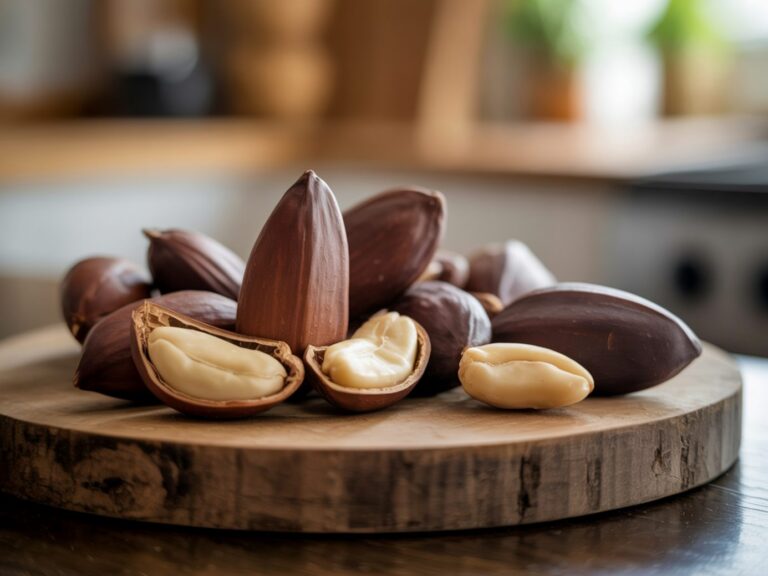
Lotus Seeds
Lotus seeds are a quietly nourishing pantry gem beloved across Asian cuisines for their mild, starchy sweetness.
In a nutshell
Lotus seeds are the edible seeds of the sacred lotus plant (Nelumbo nucifera), harvested from its distinctive seedpod. They taste mildly sweet and starchy, somewhere between a chestnut and a white bean. Dried or canned, they show up in Chinese sweet soups, moon cake fillings, and savory braises across East and Southeast Asia.
Nutrition
≈ 45 Calories and 0.3g fat per tablespoon.
Lotus seeds punch well above their delicate flavor in the nutrition department. Protein accounts for roughly 15–18% of dry weight — a meaningful contribution for a seed, though not quite a third of dry weight. The carbohydrate load is mostly complex starch that digests more slowly than refined grains, giving you steady energy rather than a sugar spike. Fat content is minimal and skews toward unsaturated types. Traditional Chinese medicine has long prized lotus seeds for calming properties, and modern research points to compounds like neferine, liensinine, and quercetin that have shown antioxidant and mild anti-inflammatory activity in laboratory studies. The seeds also contribute meaningful amounts of potassium, magnesium, and phosphorus, supporting muscle function and bone health. Nutrition per 100 g.
Culinary uses & pairings
In Chinese and Vietnamese cooking, dried lotus seeds are most famously simmered into sweet soups (tong sui) with rock sugar, jujubes, or longan, where they absorb liquid and turn silky-tender. They’re also braised whole in savory dishes alongside pork belly or duck, lending a subtle earthiness that balances rich meats. Ground into a smooth paste with sugar and oil, they become the classic lotus seed paste used to fill moon cakes, tang yuan, and steamed buns.
Fresh or canned lotus seeds can be eaten almost straight from the pod with just a quick rinse, tossed into rice congee, or folded into sticky rice stuffings for lotus-leaf-wrapped parcels. Because they hold their shape well under heat, they work beautifully in slow cooker soups and braised dishes where softer ingredients would dissolve. A quick tip for dried seeds: soak them for several hours or overnight, then use a toothpick to remove the bitter green embryo running through the center before cooking.
Pairs well with
Substitutions
Buying & storage
Dried lotus seeds are the most versatile form and are widely available in Asian grocery stores and online; look for seeds that are uniformly cream to pale yellow in color without dark spots or a musty smell. Avoid bags with lots of broken seeds or a grayish tinge, which signals age. Canned lotus seeds (already cooked and often peeled) are a real time-saver and are perfectly fine for soups and desserts; check that the liquid in the can is clear rather than murky. If you’re lucky enough to find fresh lotus seeds still in the seedpod at a farmers market or Asian produce stand, snap them up in late summer — they’re sweet, tender, and can be eaten raw.
Types
- Dried lotus seeds (white/peeled): The most common pantry form; hulled and dried, ready for soaking and cooking. Convenient and long-lasting.
- Dried lotus seeds (unpeeled/brown): Still in their thin reddish-brown shell; require a bit more prep but are considered fresher and more flavorful by purists.
- Canned lotus seeds: Pre-cooked and ready to use; ideal for weeknight soups and desserts when you don’t have time to soak and simmer from scratch.
- Fresh lotus seeds: Available in late summer where lotus is grown; sweet, crisp, and edible raw straight from the seedpod. A seasonal treat.
- Lotus seed paste: Processed, sweetened, and cooked into a smooth filling; sold canned or vacuum-packed and used directly in baked and steamed goods.
Recipes
We do not have recipes featuring lotus seeds in our collection just yet — but you can discover thousands of recipes, filtered to your diet and your pantry, over at Tucker Finder.
Find your next recipe
Discover thousands of recipes — matched to your diet, your pantry, and your schedule — and build a shopping list in one tap.
History & origin
The lotus plant (Nelumbo nucifera) has held a place in human culture for at least 3,000 years, revered across Asia as a symbol of purity, enlightenment, and rebirth — rising spotlessly from muddy water to bloom above the surface. Its seeds were eaten in ancient China, India, and Egypt, and Sanskrit and Chinese texts alike reference the lotus as both food and medicine. In China, lotus seed paste became a prized confection, eventually finding its way into the layered symbolism of moon cakes exchanged during the Mid-Autumn Festival. Today the plant is cultivated across Asia from China and India to Thailand and Vietnam, and lotus seeds remain a staple ingredient in traditional medicine systems including Ayurveda and Traditional Chinese Medicine.
How it’s made
The lotus plant grows in shallow ponds and marshes, producing large round seedpods that resemble a watering-can head, each holding a dozen or more individual seeds. Harvesting happens in late summer and early autumn when the seedpod matures and begins to dry — growers wade into the water or use small boats to collect the pods by hand. Fresh seeds are popped directly from the pod and sold as-is. For dried seeds, the outer hull is usually removed by machine or hand, then the seeds are sun-dried or mechanically dried until their moisture content drops low enough for long-term storage. Producers also steam and press dried seeds with sugar and oil to make the smooth lotus seed paste sold commercially.
Good to know
- Lotus seeds can remain viable for an extraordinarily long time — researchers have successfully germinated seeds estimated to be approximately 1,300 years old recovered from a dry lakebed in northeastern China.
- The bitter green embryo inside each seed is used separately in Chinese herbal medicine, brewed as a tea believed to reduce heat and calm the mind.
- Lotus seeds are called lián zǐ (莲子) in Mandarin, and gifting them is considered auspicious in Chinese culture because the word sounds similar to the phrase for ‘continuous descendants.’
- Every part of the lotus plant is edible — roots (lotus root), stems, leaves, flowers, and seeds — making it one of the most completely utilized food plants in Asian cuisine.
- Despite being botanically classified as seeds, lotus seeds behave texturally more like a legume or starchy nut when cooked, which is why they slot so naturally into both sweet and savory dishes.