Cornmeal
Cornmeal brings rustic warmth and golden color to everything from skillet cornbread to creamy polenta.
In a nutshell
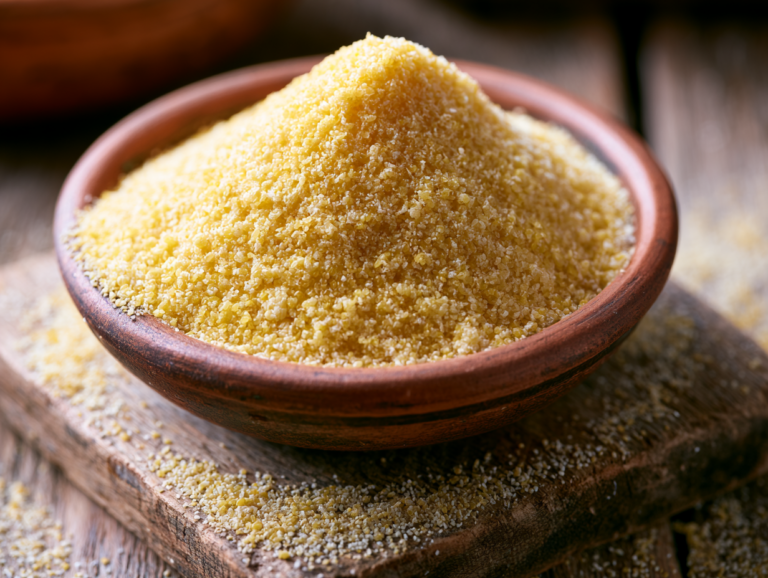
Cornmeal is dried corn ground to a coarse, medium, or fine texture. It’s a pantry staple across the American South, the Midwest, and Italian-American kitchens alike. Depending on grind and variety, it bakes into tender cornbread, simmers into silky polenta, or adds crunch to pan-fried fish.
Nutrition
≈ 52 Calories and 0.8g fat per tablespoon.
Cornmeal is a good source of complex carbohydrates, making it a steady energy source. Whole-grain (stone-ground) cornmeal delivers a meaningful amount of dietary fiber — roughly 5 to 7 grams per 100 grams — while degerminated cornmeal provides somewhat less. Its protein content is modest but real, and the fat profile leans toward heart-friendlier unsaturated fats, with monounsaturated and polyunsaturated fats together outweighing saturated fat. Whole-grain cornmeal retains the germ and bran, offering more B vitamins, magnesium, and antioxidants like lutein and zeaxanthin — carotenoids linked to eye health — compared to degerminated varieties. Sodium is negligible, which gives you full control over seasoning. Nutrition per 100g via Spoonacular.
Culinary uses & pairings
In baking and frying, cornmeal is the backbone of Southern skillet cornbread, hush puppies, and johnnycakes. A fine or medium grind keeps baked goods tender, while a coarse grind adds rustic texture and a satisfying crunch. It doubles as a breading for pan-fried catfish, okra, and chicken tenders, producing a crisp, golden crust that stays put.
Simmered low and slow in water, broth, or milk, cornmeal transforms into polenta or grits — creamy, comforting bases for braised meats, sautéed mushrooms, or a simple knob of butter and aged cheese. It also thickens soups and stews, forms the base of tamale-style casseroles, and can be poured into a pan, chilled, sliced, and pan-fried for crispy polenta cakes.
Pairs well with
Substitutions
Buying & storage
Look for stone-ground cornmeal for the fullest corn flavor and the most nutrients — the label should say whole-grain or stone-ground. Degerminated cornmeal (common in national supermarket brands) has a longer shelf life but a blander taste. Match the grind to your purpose: fine for smooth cornbread and coating, medium for an all-purpose choice, and coarse for polenta, grits, or rustic breads. Check the packaging date, especially on stone-ground varieties, since the retained germ means the oils can go rancid faster.
Varieties and Grinds
- Stone-Ground (Whole-Grain): Ground between millstones with the germ and bran intact; robust corn flavor, shorter shelf life, best for artisan cornbread and grits.
- Degerminated (Steel-Ground): The germ is removed before milling; milder flavor, longer shelf life, the most common supermarket variety.
- Fine Grind: Smooth texture ideal for delicate cornbread, corn muffins, and coatings; blends easily into batters.
- Medium Grind: The everyday workhorse — versatile enough for baking, breading, and light porridge.
- Coarse Grind: Hearty and rustic; the go-to for traditional Southern grits and Italian polenta with satisfying body.
- Blue Cornmeal: Made from blue corn; slightly nuttier in flavor than yellow, with a striking blue-gray color and marginally higher protein content.
- White Cornmeal: Preferred in parts of the South for cornbread; milder and less sweet than yellow with a paler crumb.
Recipes using cornmeal
56 recipes across our recipe sites use cornmeal. A few favorites:
Cooking with cornmeal tonight?
Find cornmeal recipes that match your diet — keto, high-protein, vegan, under 30 minutes — and build a shopping list in one tap.
History & origin
Corn was first domesticated in southern Mexico roughly 9,000 years ago, and indigenous peoples across the Americas had been grinding dried corn into meal long before European contact. Native nations taught European colonists to mill corn and use cornmeal for bread and porridge, which became survival staples in early American settlements. Johnnycakes fed Colonial-era travelers, cornbread nourished Civil War soldiers on both sides, and polenta sustained generations of northern Italian immigrants who brought their own corn-milling traditions to the New World. By the 19th century, water-powered grist mills dotted nearly every American river and creek, and cornmeal was among the most widely consumed grain products in the country.
How it’s made
Cornmeal starts with field (dent) corn that is harvested and fully dried to reduce moisture to around 14 percent. In stone-ground milling, whole dried kernels pass between two heavy millstones that crush the germ, bran, and endosperm together, preserving the natural oils and flavor. In the more common steel roller milling process, the germ and bran are removed first — a step called degermination — and the remaining endosperm is ground between steel rollers to a consistent, shelf-stable powder. The meal is then bolted (sifted) to separate fine, medium, and coarse grades before packaging. Some specialty producers dry-roast the corn before milling to deepen its flavor.
Good to know
- The United States grows more corn than any other country on Earth, yet only a small fraction of that crop becomes cornmeal — most is used for animal feed, ethanol, or sweeteners such as high-fructose corn syrup.
- Cornbread made without sugar is a point of fierce regional pride in the American South, where sweetened cornbread is sometimes considered a Midwestern or Northern innovation.
- Polenta and grits are made from the same basic ingredient — coarsely ground dried corn — but they traditionally come from different corn varieties, which gives each a subtly distinct flavor.
- Blue cornmeal gets its striking color from anthocyanins, the same antioxidant pigments found in blueberries and red cabbage.
- Before refrigeration, dried cornmeal kept frontier and farm families fed through winters when fresh food was scarce, making it one of the most historically important pantry staples in American cooking.