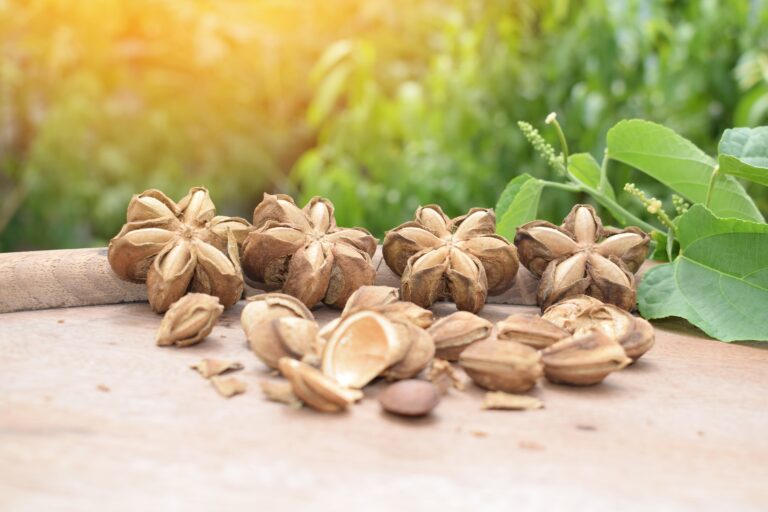
Candlenuts
Candlenuts are the secret to silky, rich curry pastes across Southeast Asian kitchens.
In a nutshell
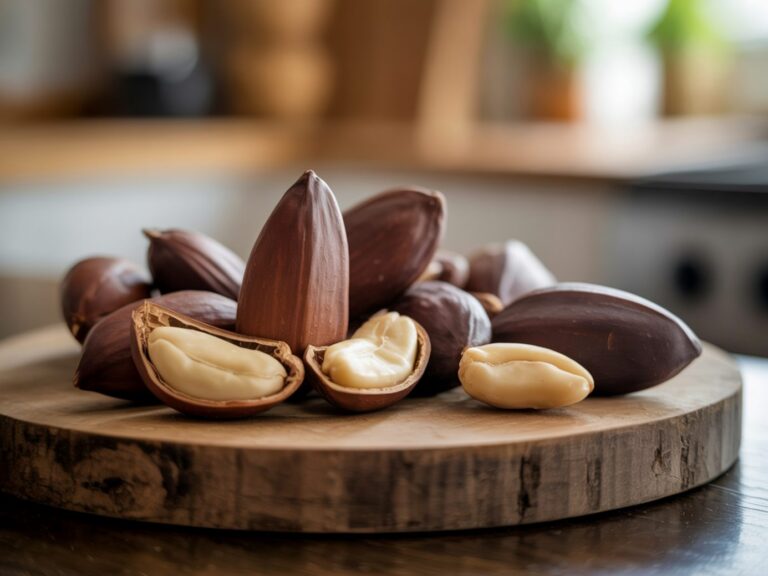
Candlenuts are cream-colored, waxy nuts native to Southeast Asia and the Pacific, used almost exclusively as a culinary thickener and emulsifier rather than a snack. They have a mild, faintly bitter flavor raw but turn buttery and mellow once cooked into spice pastes. They’re an essential ingredient in Indonesian, Malaysian, and Hawaiian cuisines.
Nutrition
≈ 64 Calories and 6.8g fat per tablespoon.
Candlenuts are extraordinarily high in fat — the vast majority of their calories come from lipids — making them one of the fattiest tree nuts used in cooking. Because they’re used in small quantities as a paste ingredient rather than eaten by the handful, that richness translates into a luxurious body in finished dishes rather than a heavy nutritional load per serving. They also contribute a modest amount of plant-based protein. Important safety note: candlenuts contain toxic compounds when raw and should always be cooked before eating. Nutrition per 100 g.
Culinary uses & pairings
Candlenuts are ground into spice pastes — called bumbu in Indonesian cooking and rempah in Malaysian — where they act as a natural thickener and fat source, giving curries, rendang, and satay sauces their characteristic creamy, clinging body. Just two to four nuts can transform a loose spice mixture into a rich, cohesive paste that coats meat and vegetables beautifully.
In Hawaiian cooking, roasted and mashed candlenuts form the base of inamona, a traditional condiment made with sea salt that’s stirred into poke. Beyond Southeast Asia and Hawaiʻi, adventurous US home cooks use them to thicken coconut-based soups and braises whenever they want a subtler, nuttier richness than cornstarch or flour would provide.
Pairs well with
Substitutions
Buying & storage
Look for candlenuts at Asian grocery stores, particularly those specializing in Southeast Asian ingredients, where they’re typically sold in small plastic bags or vacuum-sealed pouches. Choose nuts that are uniformly pale cream to ivory in color with no dark spots, off smells, or signs of moisture — their high fat content makes them prone to rancidity. In the US, they’re sometimes labeled under their Indonesian name kemiri or their Malay name buah keras. If you can’t source them locally, they’re widely available from online specialty retailers.
Recipes
We do not have recipes featuring candlenuts in our collection just yet — but you can discover thousands of recipes, filtered to your diet and your pantry, over at Tucker Finder.
Find your next recipe
Discover thousands of recipes — matched to your diet, your pantry, and your schedule — and build a shopping list in one tap.
History & origin
The candlenut tree (Aleurites moluccanus) is native to the Indo-Pacific region and has been cultivated for thousands of years across Indonesia, Malaysia, the Philippines, and Polynesia. Its common English name comes from the nut’s traditional use as a primitive candle — the oil-rich kernels were threaded on a palm-leaf midrib and burned sequentially as a time-keeping light source in Hawaii and the Pacific Islands. Polynesian voyagers carried the tree throughout the Pacific, which is why it turns up in Hawaiian culture as a deeply sacred plant, designated the official state tree of Hawaii in 1959. In Southeast Asia it has always been prized more for cooking than for light, anchoring spice paste traditions that predate written culinary records.
How it’s made
Candlenuts grow on a fast-spreading tropical tree that thrives in humid, lowland climates. The tree produces clusters of hard, round fruits, each containing one or two thick-shelled nuts roughly the size of a large marble. After harvest, the outer husks are removed and the hard shells are cracked — often by hand or with a wooden mallet — to reveal the creamy white kernel inside. The kernels are dried and then sold as-is or lightly roasted. Because they’re never eaten raw in quantity, there is little commercial processing beyond drying; most of the value lies in the fresh, unroasted kernel that home cooks and restaurant kitchens grind fresh into pastes.
Good to know
- Candlenuts are toxic in large quantities when eaten raw — they contain compounds including phorbol esters that are known irritants and can cause nausea and vomiting, which is why they’re always cooked into dishes rather than snacked on.
- The candlenut is the official state tree of Hawaii, where it’s known as kukui and considered a symbol of enlightenment and protection.
- Traditional Hawaiian inamona — roasted, salted candlenut paste — is the authentic seasoning for poke and has been made on the islands for centuries.
- The oil pressed from candlenuts is used in Southeast Asian haircare traditions and is increasingly sold in the US as a luxury hair treatment oil.
- A single candlenut threaded on a palm-leaf midrib would burn for roughly three to four minutes, making a string of them a reliable countdown clock in pre-modern Pacific cultures.