Mustard Seeds
Tiny but mighty, mustard seeds unlock bold, nutty flavor the moment they hit a hot pan.
In a nutshell
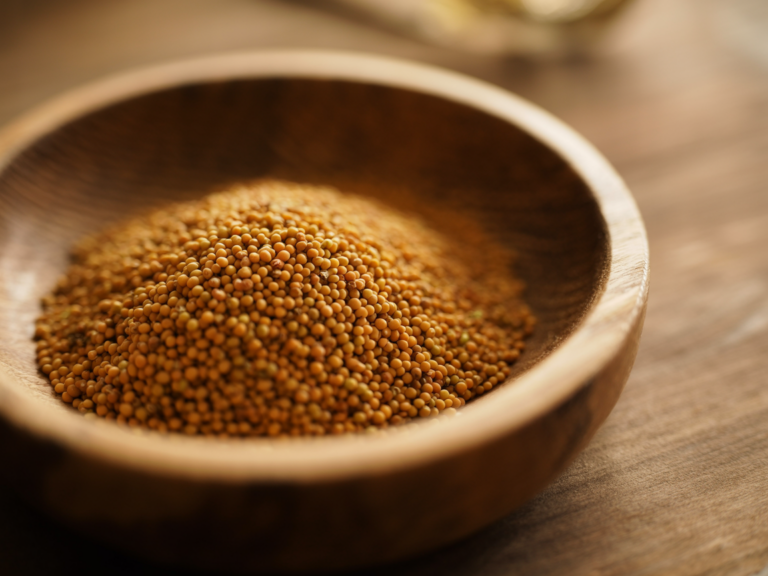
Mustard seeds are the small, round seeds of the mustard plant, used whole, cracked, or ground across nearly every global cuisine. They range from mild and nutty (yellow) to fiery and pungent (brown and black). Pop them in hot oil and they bloom into something toasty and aromatic that no powder can replicate.
Nutrition
≈ 69 Calories and 4.9g fat per tablespoon.
Mustard seeds punch well above their weight nutritionally. They deliver a meaningful amount of protein for a spice, though like most plant proteins it is not considered complete without complementary foods. The fat profile skews toward heart-friendly monounsaturated fats, with a solid share of polyunsaturated omega-3 and omega-6 fatty acids. A generous fiber content supports digestive health, and the seeds are rich in selenium, magnesium, and manganese — minerals tied to antioxidant defense and bone health. Glucosinolates, the sulfur compounds responsible for mustard’s signature heat, have attracted research interest for potential anti-inflammatory and other health-protective properties. Nutrition per 100 g.
Culinary uses & pairings
In Indian and South Asian cooking, whole mustard seeds are the first thing to go into a hot pan of oil — a technique called tempering or tadka. They sizzle and pop within seconds, releasing a warm, nutty depth that forms the flavor backbone of dals, curries, chutneys, and vegetable dishes. Brown and black seeds are preferred here because their assertive heat holds its own against bold spices like turmeric and chili.
In Western kitchens, whole yellow seeds are indispensable to pickling brines — they show up in bread-and-butter pickles, dill pickles, and corned beef spice packets for good reason, lending mild heat and a pleasantly chewy bite. Ground or cracked seeds go into dry rubs, vinaigrettes, and homemade mustard condiments, while cracked seeds folded into potato salad or coleslaw add little bursts of texture and flavor that pre-made mustard simply can’t match.
Pairs well with
Substitutions
Buying & storage
Look for seeds with a uniform, deep color and no signs of moisture, clumping, or a musty smell. Black seeds are the smallest and most pungent; brown seeds are slightly larger and almost as hot — these two are the workhorses of South Asian cooking. Yellow (white) seeds are the largest and mildest, ideal for pickling and homemade American-style mustard. Buy from a store with high turnover — a bulk spice shop or well-stocked Indian or international grocery will almost always have fresher stock than a dusty supermarket jar. Opt for whole seeds over pre-ground when you can, since ground mustard loses its volatile heat compounds within months.
Varieties
- Yellow (White) Mustard Seeds: The largest and mildest of the three, with a pale golden color. These are the standard pickling seed and the base for classic American yellow mustard. Their heat is upfront but fades relatively quickly.
- Brown Mustard Seeds: Smaller and more pungent than yellow, with a warm reddish-brown hue. The dominant seed in South Asian cooking and a primary component in Dijon-style mustards. They hold their heat well even after cooking.
- Black Mustard Seeds: The smallest and most intensely flavored variety, common in Indian and some Middle Eastern cuisines. They’re nearly interchangeable with brown seeds in most recipes but deliver an extra layer of sharp, complex heat.
- Oriental Mustard Seeds: A distinct species (Brassica juncea) grown widely in Asia and Canada, used both as a culinary spice and for mustard oil production. Less common in US home kitchens but an important commercial crop in South Asian cooking contexts.
Recipes using mustard seeds
5 recipes across our recipe sites use mustard seeds. A few favorites:
Cooking with mustard seeds tonight?
Find mustard seeds recipes that match your diet — keto, high-protein, vegan, under 30 minutes — and build a shopping list in one tap.
History & origin
Mustard is one of the oldest cultivated spice plants in human history, with seeds found at prehistoric sites and references appearing in ancient Sanskrit texts. The ancient Egyptians and Romans used the seeds medicinally and culinarily, and Roman writers documented mustard preparations used as condiments throughout the empire — helping spread cultivation across Europe. In the Bible, the mustard seed became a symbol of faith precisely because of its near-invisible size and outsized growth. By the Middle Ages, mustard had become economically significant across Europe, and the city of Dijon in Burgundy, France, was already establishing the reputation it carries to this day.
How it’s made
Mustard plants — members of the Brassica and Sinapis genera — are cool-season annual crops that thrive in temperate climates. Canada, Nepal, Russia, and Ukraine are among the world’s largest producers. The plants produce clusters of small yellow flowers that develop into long seedpods, each containing a row of tiny round seeds. Once the pods ripen and dry on the stalk, the crop is mechanically harvested and threshed to separate the seeds from the plant material. The raw seeds are then cleaned, sorted by size and color, and either sold whole or further processed: cracking produces a coarse texture ideal for spice rubs and pickling, cold-pressing extracts the oil, and fine grinding creates the dry mustard powder sold in tins. Notably, whole mustard seeds are virtually odorless until cracked or moistened — the sharp, pungent aroma only develops when the enzyme myrosinase contacts water and breaks down glucosinolates into volatile isothiocyanates.
Good to know
- Mustard seeds are essentially odorless until broken — the iconic pungent aroma is a chemical reaction triggered only when the seed’s inner enzymes meet moisture.
- The mustard plant belongs to the same family (Brassicaceae) as broccoli, cabbage, and kale, which is why all of them share those signature sulfur-forward flavor notes.
- Canada is consistently one of the world’s largest mustard seed producers and the leading exporter, sending a substantial share of its crop to Europe for condiment production.
- In Ayurvedic medicine, mustard seeds have been used for centuries as a warming spice believed to stimulate digestion and improve circulation.
- A single mustard plant can produce a very large number of seeds — which is precisely why the biblical parable chose it to illustrate how something small can grow into something enormous.