Celery
Celery is the crunchy, aromatic backbone of countless kitchens — humble, versatile, and always ready to earn its place.
In a nutshell
Celery is a crisp, pale-green stalk vegetable with a savory, mildly bitter flavor and a satisfying crunch. It’s a foundational aromatic in Western cooking, appearing in stocks, soups, and braises. Low in calories and high in water content, it’s equally at home on a crudité platter as it is slow-cooking in a stew.
Nutrition
≈ 2 Calories and 0g fat per tablespoon.
Celery is remarkably low in calories — a full cup barely registers — making it a go-to for anyone watching their intake without sacrificing volume or satisfaction. Its fiber supports healthy digestion, and it delivers a notable hit of natural sodium for a vegetable, which matters for low-sodium cooks who need to account for it. Celery is a solid source of vitamin K, important for blood clotting and bone health, along with vitamin C and potassium. It also contains phthalides, plant compounds studied for their potential to support healthy blood pressure by relaxing artery walls. Nutrition per 100g via Spoonacular.
Culinary uses & pairings
Celery is the quiet workhorse of the aromatic world. Diced alongside onion and carrot, it forms the classic mirepoix that builds depth into stocks, soups, stews, and braises. The leaves — often discarded — are actually packed with flavor and work beautifully as an herb: toss them into salads, stir them into tabbouleh, or use them as a garnish anywhere you’d reach for flat-leaf parsley.
Raw celery shines as a snacking and fresh-prep ingredient. Fill the hollow stalks with peanut butter or cream cheese for a classic snack, or slice them thin on the bias for Waldorf salad, chicken salad, or tuna salad where crunch is the point. Celery is also a favorite juicing ingredient, lending a clean, green, savory note that balances sweeter fruits and vegetables in cold-pressed blends.
Pairs well with
Substitutions
Buying & storage
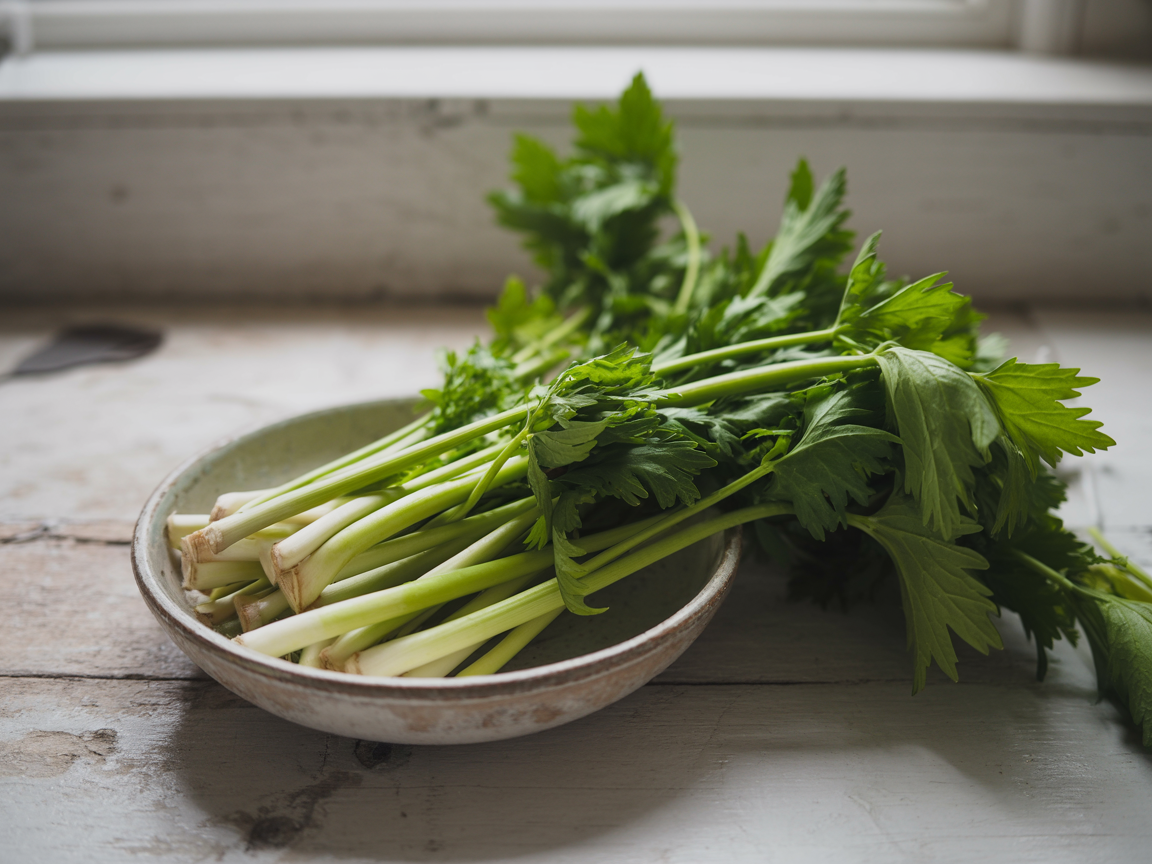
Look for celery bunches with firm, tightly packed stalks that snap cleanly rather than bending — limpness is the first sign of age. The stalks should be a bright, even pale to medium green with no brown spots, hollow centers, or slimy patches near the base. Leaves, when present, should look fresh and perky rather than yellowed or wilted; leafy tops are actually a freshness indicator worth checking. The outer stalks carry more concentrated aromatics and shouldn’t be discarded in favor of hearts alone if full flavor is the goal.
Varieties
- Pascal (green celery): The standard supermarket type; thick, meaty stalks with robust flavor and good crunch — the everyday workhorse.
- Golden (yellow celery): Blanched during growing to reduce bitterness; milder, more tender, and sweeter than green celery — prized in European cooking.
- Red celery: An heirloom variety with reddish-pink stalks and a slightly stronger, more complex flavor; mostly found at farmers’ markets.
- Leaf celery (cutting celery): Grown for its intensely flavored leaves rather than thick stalks; used as an herb in Southeast Asian cooking and French cuisine.
- Celery root (celeriac): A close relative bred for its bulbous root rather than stalks; nutty, earthy celery flavor used in purees, slaws, and gratins.
Recipes using celery
354 recipes across our recipe sites use celery. A few favorites:
Cooking with celery tonight?
Find celery recipes that match your diet — keto, high-protein, vegan, under 30 minutes — and build a shopping list in one tap.
History & origin
Celery has a lineage stretching back over 3,000 years, though its earliest forms — wild smallage — were far more bitter and leaf-heavy than what we know today. Ancient Egyptians and Greeks used it medicinally and ceremonially; archaeological evidence shows wild celery in Egyptian tombs, and Greek athletes at the Nemean and Isthmian games were associated with wild celery wreaths rather than the laurel used at Olympia. Romans embraced it as a flavoring agent and digestive aid. The mild, thick-stalked celery we eat today was developed in northern Italy in the 17th century and gradually spread across Europe before arriving in North America with early settlers, where it became a beloved table vegetable by the 19th century.
How it’s made
Celery is a biennial plant grown as an annual, requiring cool temperatures and consistent moisture to develop its characteristic crunch and mild flavor. Seeds are started indoors weeks before transplanting, as the growing season is long. Once in the ground, celery demands steady irrigation and rich, well-drained soil — it’s one of the more demanding commercial crops. Conventional growers sometimes practice blanching, mounding soil or wrapping stalks to block sunlight, which reduces bitterness and lightens the color, though most modern commercial production uses varieties that don’t require it. Most US commercial celery comes from California’s Central Valley and Michigan, harvested mechanically by cutting the entire head just below the soil line.
Good to know
- Celery is about 95% water, making it one of the most hydrating vegetables you can eat.
- The ancient Greeks called wild celery selinon — the same root that gives the ancient city of Selinunte, Sicily, its name, because wild celery grew abundantly in that region.
- Celery seeds used in cooking come from a related wild plant, Apium graveolens var. secalinum or closely related wild types, rather than from standard stalk celery, and pack a concentrated punch of flavor.
- The inner yellow stalks and leaves of a celery bunch are naturally blanched by the outer stalks blocking sunlight, which is why they’re milder and more tender.
- Celery was considered a luxury item in 19th-century America, and Victorian-era restaurants displayed it upright in elegant glass vases as a sign of fine dining.