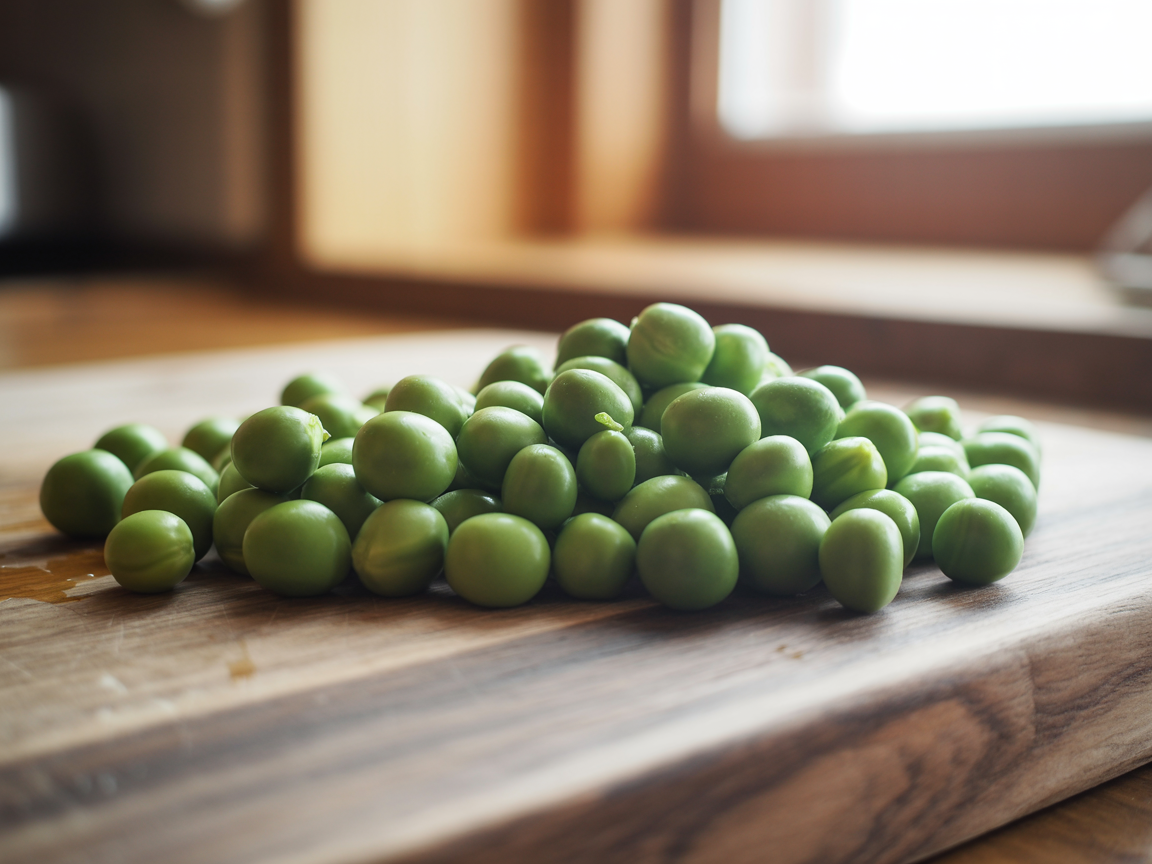
Mung Beans
Mung beans are a pantry hero that deliver big protein and fiber in a tiny, versatile package perfect for every skill level.
In a nutshell
Mung beans are small, oval legumes with a bright green skin and pale yellow interior that cook faster than most dried beans. They’re a staple across South and East Asian kitchens and are equally at home in savory soups, sweet desserts, and fresh sprouts. Their mild, slightly sweet flavor makes them one of the friendliest legumes for cooks new to the dried-bean world.
Nutrition
≈ 47 Calories and 0.2g fat per tablespoon.
Mung beans punch well above their weight nutritionally. They deliver roughly 23 to 24 grams of protein per 100 g dry weight—a solid amount for a plant food, though mung bean protein is not complete on its own, as it is relatively low in methionine. Their impressive 16-plus grams of dietary fiber supports gut health and helps sustain steady blood sugar levels, which is why they’re often recommended in diets for metabolic health. They’re rich in folate, iron, magnesium, and potassium, and they contain antioxidants like vitexin and isovitexin that have been linked to reduced inflammation. Despite all that nutrient density, they’re naturally very low in fat and sodium, making them an easy fit in heart-healthy eating patterns. Nutrition per 100g via Spoonacular.
Culinary uses & pairings
Mung beans shine in soups and dals—simmer them whole or split until creamy and finish with a tadka of ghee, cumin, and garlic for a classic Indian dal. They’re equally popular in Southeast Asian congees and Filipino monggo stew, where they absorb savory broth beautifully. Because they cook in as little as 30 to 45 minutes without soaking, they’re a weeknight-friendly swap for longer-cooking legumes.
One of the most popular uses is sprouting: rinse, soak overnight, and let them sprout in a jar for two to three days to produce crunchy, fresh bean sprouts perfect for pad thai, spring rolls, and salads. Split and hulled mung beans (moong dal) dissolve into silky porridges and savory pancakes like Korean bindaetteok, and ground mung bean starch is the base for delicate glass noodles used across Asian cuisines.
Pairs well with
Substitutions
Buying & storage
Look for mung beans that are uniformly bright green with a slight sheen and no visible shriveling, cracks, or dullness—faded color often signals age. Whole mung beans, split mung beans (moong dal with skin), and hulled yellow moong dal are all sold in Indian and Asian grocery stores as well as many mainstream supermarkets. Buying from stores with high turnover is key because older beans take longer to cook and never get quite as creamy. Bags are preferable to bulk bins if you’re unsure of freshness, since packaging usually carries a best-by date.
Types
- Whole mung beans: The green-skinned whole bean; holds its shape during cooking and is ideal for soups, stews, and sprouting.
- Split moong dal (with skin): Halved with the green skin still on; cooks faster than whole beans and has a slightly earthier flavor.
- Hulled yellow moong dal: Split and skinned to reveal the yellow interior; dissolves into a silky, mild porridge or dal and is easiest to digest.
- Mung bean sprouts: Sprouted whole beans sold fresh; crunchy and a source of vitamin C, used raw or briefly cooked in stir-fries and salads.
- Mung bean flour: Ground from hulled beans; used in Korean savory pancakes, Indian snacks, and various Asian sweets. Glass noodles are made from mung bean starch rather than whole mung bean flour.
Recipes
We do not have recipes featuring Mung Beans in our collection just yet — but you can discover thousands of recipes, filtered to your diet and your pantry, over at Tucker Finder.
Cooking with mung beans tonight?
Find mung beans recipes that match your diet — keto, high-protein, vegan, under 30 minutes — and build a shopping list in one tap.
History & origin
Mung beans have been cultivated for at least 3,500 to 4,500 years, with their origins traced to the Indian subcontinent—specifically the region that is now northwestern India and possibly Pakistan, with secondary domestication or early spread into Myanmar and Southeast Asia. From there, trade routes carried them across Southeast Asia, China, and eventually into the Middle East and Africa. Ancient Sanskrit texts reference mung beans as a medicinal food, and Ayurvedic tradition has long praised them for being easy on digestion. Chinese records dating back over 2,000 years document their use both as food and in traditional medicine. Today they’re grown commercially across India, China, Southeast Asia, and increasingly in the United States, where they’ve earned a foothold in health-food culture.
How it’s made
Mung beans are an annual legume (Vigna radiata) grown in warm, tropical and subtropical climates with well-drained soil. The plant is a short, bushy herb that produces slender pods, each typically holding 10 to 15 seeds. After the pods dry on the plant, they’re harvested—largely by machine in commercial operations—and the seeds are threshed, cleaned, and dried to a low moisture level for shelf stability. For split and hulled products, the whole beans pass through mills that crack the seed coat and separate it from the cotyledon using air separation. Mung bean sprouts are produced by soaking the beans in water and allowing germination in a humid, temperature-controlled environment for two to five days.
Good to know
- Mung beans are one of the few legumes that don’t require soaking before cooking—a huge time-saver on busy weeknights.
- The glass noodles (cellophane noodles) in your favorite Asian takeout are almost always made from mung bean starch.
- Mung beans are considered easier to digest than many other legumes because they contain relatively lower levels of the oligosaccharides that cause gas.
- In Ayurvedic medicine, mung bean dal is considered a tridoshic food—balancing for all body types—and is often recommended as a light, cleansing meal.
- China and India together account for the vast majority of global mung bean production, but the US has been quietly expanding commercial acreage to meet growing domestic demand.